


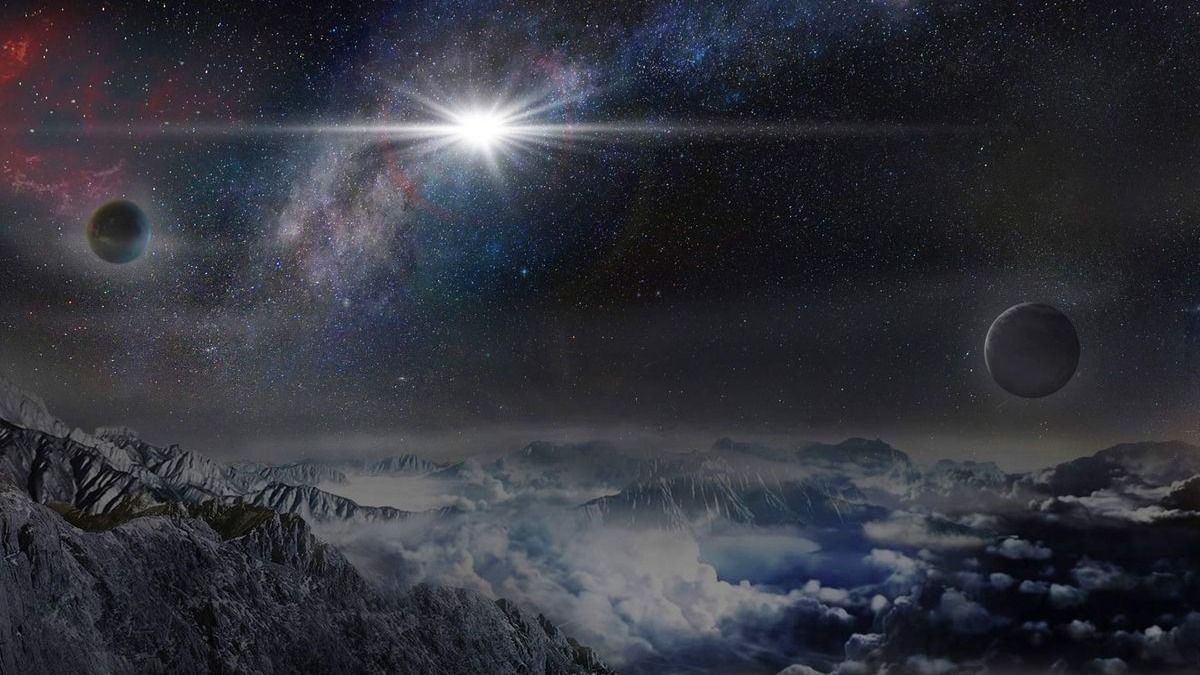
Webb Telescope Captures First Surface Image of Exoplanet LHS 3844 b
Translated from Hungarian, summarized and contextualized by DistantNews.
TLDR
- The James Webb Space Telescope has observed the surface of exoplanet LHS 3844 b for the first time.
- The planet is a hot, barren, rocky world with no atmosphere, orbiting a red dwarf star every 11 hours.
- Analysis suggests the surface is dominated by basalt, indicating volcanic activity rather than water-driven geological processes.
The James Webb Space Telescope continues to push the boundaries of astronomical discovery, offering unprecedented views of distant worlds. Recent observations have allowed scientists to study the surface of exoplanet LHS 3844 b, revealing a harsh and inhospitable environment.
We are looking at a dark, hot, barren rocky body without any atmosphere.
This rocky exoplanet, located just 48.6 light-years away, orbits its red dwarf star in a mere 11 hours. Its proximity to the star results in extreme temperatures on its day side, reaching approximately 725 degrees Celsius. The planet is tidally locked, meaning one side perpetually faces its star while the other remains in eternal darkness.
This planet likely contains very little water.
Analysis of the infrared light emitted from LHS 3844 b's day side, conducted by a team led by Sebastian Zieba of the Harvard & Smithsonian Center for Astrophysics, suggests a surface primarily composed of basalt. This volcanic rock, common on bodies like the Moon and Mercury, points to significant volcanic activity shaping the planet. Unlike Earth, LHS 3844 b appears to lack the water-driven geological processes and plate tectonics that form silicon-dioxide and granite-rich crusts.
If these gases were present in reasonable quantities on LHS 3844 b, MIRI should have detected them.
The absence of significant atmospheric gases like carbon dioxide or sulfur dioxide, which would be expected from such geological activity, further emphasizes the planet's desolate nature. While the discovery highlights the JWST's powerful capabilities, it also underscores the vast diversity of planetary environments in our galaxy, with LHS 3844 b standing out as a stark example of a world utterly unsuitable for life as we know it.
Yet it found nothing.
DistantNews Editorial
Originally published by Magyar Nemzet in Hungarian. Translated, summarized, and contextualized by our editorial team with added local perspective. Read our editorial standards.
More Stories



From Our Blog

Countries Without a Free Press: What You Need to Know

What Press Freedom Means for the News You Read

What Gets Lost (and Found) When News Is Translated

The Critical Role of Diaspora Media in Global News

What Travellers Should Know About Countries with Restricted Press
