


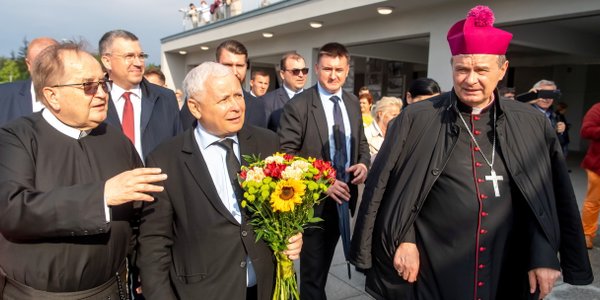
Wojnicki: State-Church Relations Stabilized for 30 Years, Now Threatened by Progressive and National-Catholic Trends
Translated from Polish, summarized and contextualized by DistantNews.
TLDR
- A Polish political scientist argues that the model of state-church cooperation established after 1989 has been destabilized by both progressive and national-Catholic trends.
- Professor Jacek Wojnicki criticizes the previous United Right government's close alliance with the Church as particularly damaging.
- He references new books discussing the relationship between the state and the Catholic Church in Poland within a European context.
The relationship between the state and the Church in Poland, a cornerstone of our socio-political order since 1989, is facing unprecedented challenges. For over three decades, a carefully crafted model of autonomy and cooperation has provided stability. However, as Professor Jacek Wojnicki of the University of Warsaw points out, this equilibrium is now threatened by opposing forces.
Wojnicki specifically identifies both left-wing progressive movements and certain national-Catholic factions as detrimental to this established order. His critique is particularly sharp regarding the years of rule by the United Right coalition. He describes their approach, a consistent pursuit of an "Altar and Throne" alliance, as "devastating," lacking a forward-looking vision despite its perceived ideological coherence.
Particularly devastating were the years of rule by the United Right, and especially the scenario of a close "Altar and Throne" alliance, pursued quite consistently, albeit without a long-term vision.
This analysis, presented in Rzeczpospolita, underscores a uniquely Polish debate. While Western European nations have largely secularized or maintain different models of church-state relations, Poland's post-communist transition saw the Catholic Church play a pivotal role in national identity and rebuilding civil society. The current discussions, reflected in recent publications like "Europeanization of Religious Freedom. The Case of Poland" and "Altar in the Shadow of the Pandemic," highlight the ongoing struggle to define the Church's place in a modernizing, Europeanizing Poland.
The article delves into the historical context, tracing the Church's position through partitions, the Second Republic, wartime, and the communist era, before its constitutional entrenchment after 1989. This deep historical perspective is crucial for understanding the current tensions. Unlike in many Western countries where church-state relations are often viewed through a lens of separation or secular governance, in Poland, the Church's historical significance and its role in the transition from communism make its relationship with the state a deeply ingrained and sensitive issue.
The model of cooperation between the State and the Church, shaped after 1989, has been in place for over 30 years, stabilizing the socio-political situation.
DistantNews Editorial
Originally published by Rzeczpospolita in Polish. Translated, summarized, and contextualized by our editorial team with added local perspective. Read our editorial standards.
More Stories


From Our Blog

What Gets Lost (and Found) When News Is Translated

The Critical Role of Diaspora Media in Global News

What Travellers Should Know About Countries with Restricted Press

A Digital Nomad's Guide to Following Local News

How the Same Story Looks Different in Different Countries
