

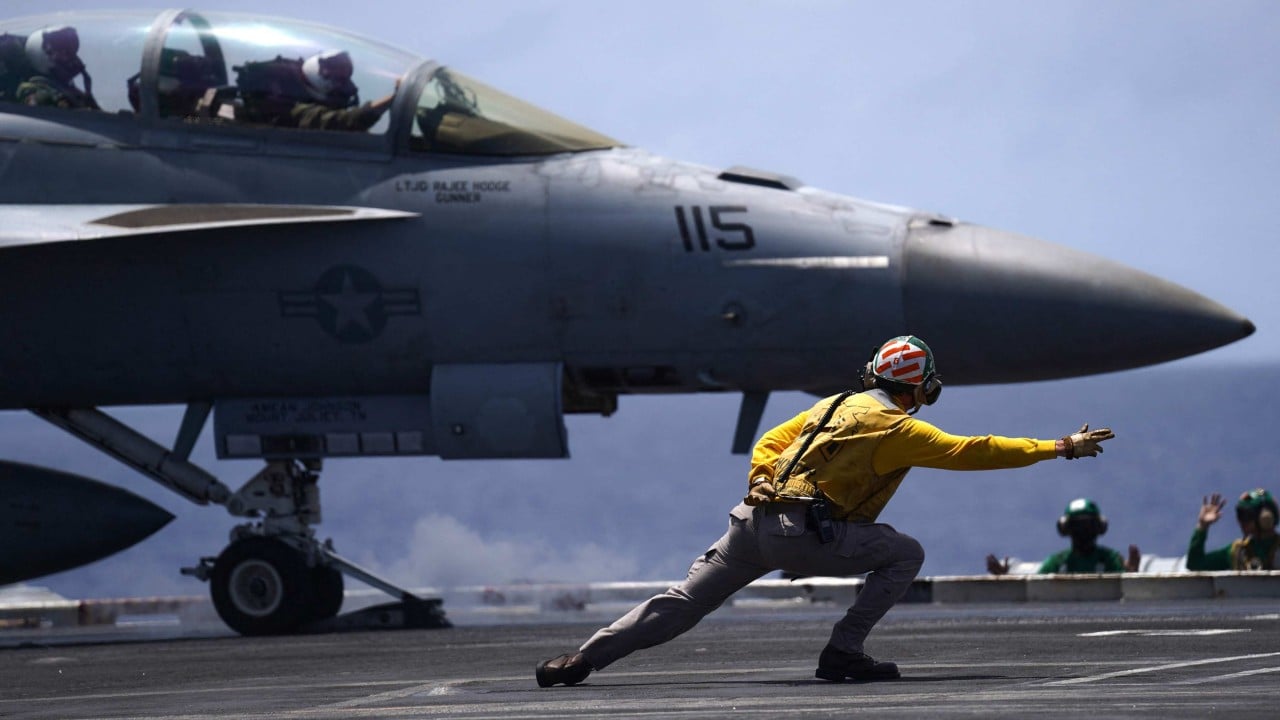
America declares international law for thee but not for me
Summarized and contextualized by DistantNews.
At a glance
Analysis
Sources not specified
Context piece
- The US declared war on the International Criminal Court (ICC), calling its existence an "intolerable" challenge to American sovereignty.
- Simultaneously, the US led a coalition supporting a 10-year-old international maritime law ruling against Beijing in the South China Sea.
- The article questions the US's selective application of international law, noting it is not a party to either the ICC or the UN Convention on the Law of the Sea.
The United States has adopted a seemingly contradictory stance on international law, simultaneously challenging the International Criminal Court (ICC) while endorsing a maritime arbitration ruling against China. This dual approach raises questions about the US's selective adherence to global legal frameworks.
In Orwellian totalitarianism, two plus two can equal five. But with American hegemony, things can be A and not A at the same time.
Earlier this month, Washington declared its opposition to the ICC, asserting that the court's existence poses an "intolerable" threat to American sovereignty. This strong condemnation signals a deep-seated US skepticism towards international judicial bodies that could potentially investigate or prosecute American citizens.
Washington declared war on the International Criminal Court (ICC), whose very existence, it claims, poses an “intolerable” challenge to America’s sovereignty.
However, in a separate development, the US led a coalition of 14 predominantly Western countries in issuing a joint statement that supports a decade-old South China Sea arbitration ruling against Beijing. This ruling, based on international maritime law, invalidated most of China's expansive claims in the disputed waters, often referred to as the nine-dash line.
But, citing an international maritime law, it also led a coalition of 14 mainly Western countries in issuing a joint statement in support of a 10-year-old South China Sea arbitration ruling against Beijing.
The article points out the apparent inconsistency in the US position. It questions whether arbitral tribunals, when ruling against states, pose any less of a challenge to sovereignty than the ICC or other international courts. Notably, the US is not a signatory to the Rome Statute, the treaty that established the ICC, nor is it a party to the UN Convention on the Law of the Sea (Unclos), which formed the basis for the South China Sea arbitration. This lack of formal participation in the foundational agreements for both legal frameworks further complicates the US's assertive stance.
Here’s the question: when they rule against states, don’t arbitral tribunals at The Hague pose as much of a challenge to their sovereignty as the ICC or any international court?
DistantNews Editorial
Originally published by South China Morning Post. Summarized and contextualized by our editorial team with added local perspective. Read our editorial standards.
More Stories
From Our Blog

Countries Without a Free Press: What You Need to Know

What Press Freedom Means for the News You Read

What Gets Lost (and Found) When News Is Translated

The Critical Role of Diaspora Media in Global News

What Travellers Should Know About Countries with Restricted Press
