


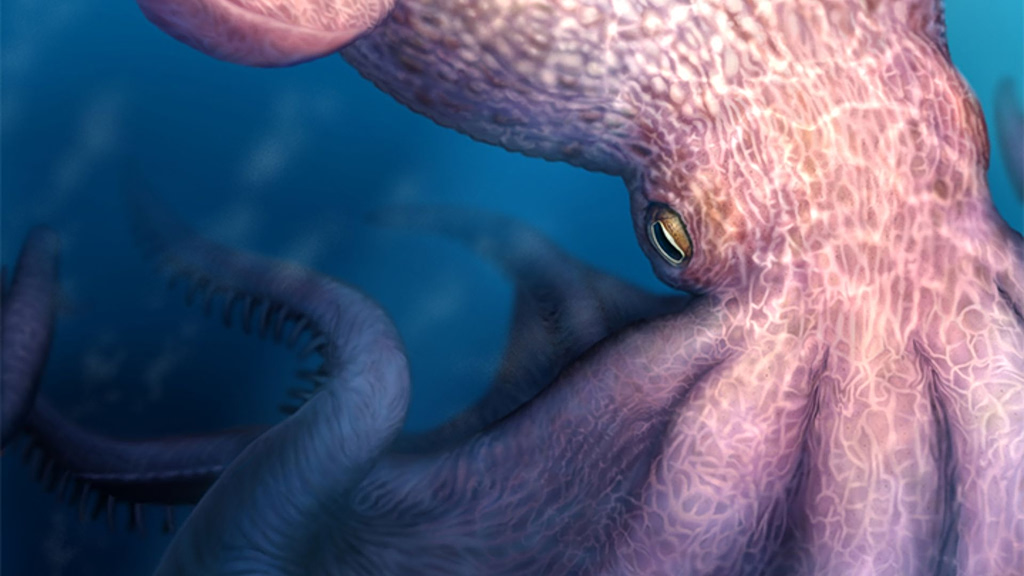
Ancient Giant Octopus Discovered, Resembling Mythical Kraken That Devoured Ships (Video)
Translated from Greek, summarized and contextualized by DistantNews.
TLDR
- Scientists have identified fossils of a giant octopus, named Nanaimoteuthis haggarti, that lived approximately 86 to 72 million years ago during the Cretaceous period.
- With an estimated length of seven to nineteen meters, this ancient cephalopod was a top predator among the largest invertebrates discovered.
- The discovery, based on jaw fossils found in Japan and Canada, suggests these giant octopuses hunted large marine animals and became extinct around the same time as the dinosaurs.
The ancient oceans held wonders far beyond our modern imagination, and a recent scientific study published in *Science* has brought one of these marvels to light: a colossal octopus species that roamed the seas during the age of dinosaurs. Ta Nea reports on the discovery of *Nanaimoteuthis haggarti*, an ancient cephalopod whose jaw fossils suggest a creature of immense size, potentially reaching up to nineteen meters in length. This finding paints a vivid picture of the Cretaceous period's marine ecosystems, dominated by formidable predators.
The body of a modern giant squid can reach up to 12 meters in length, but Nanaimoteuthis haggarti is estimated to have been even larger.
Researchers, led by paleontologist Yasuhiro Iba of Hokkaido University, describe *Nanaimoteuthis haggarti* as a top predator, rivaling modern giant squids in size but likely exceeding them. The unique wear patterns on its beak-like jaw structure indicate a diet consisting of hard-shelled prey, such as large fish and crustaceans. This suggests a powerful and active hunter, a true titan of its time, whose existence challenges our perceptions of ancient marine life. The comparison to the mythical Kraken, a creature of legend capable of dragging ships to the depths, is fitting given the octopus's sheer scale and inferred power.
The extinction of *Nanaimoteuthis haggarti* around 66 million years ago, coinciding with the mass extinction event that wiped out the dinosaurs, places it firmly in the realm of prehistoric life. For contemporary swimmers and sailors, there is no cause for alarm; this magnificent creature is long gone. However, its discovery offers invaluable insights into the evolution of marine life and the complex food webs that existed millions of years ago. Ta Nea finds this discovery particularly fascinating as it underscores the dynamic nature of life on Earth and the incredible diversity that has existed throughout its history.
The wear on this creature's 'beak,' the only hard part of an octopus's body, suggests repeated crushing of hard structures like bones and shells.
This scientific revelation, pieced together from fossils found in Japan and Canada, serves as a reminder of how much we still have to learn about our planet's past. It highlights the importance of continued paleontological research in uncovering the secrets of prehistoric ecosystems and the creatures that inhabited them. The story of *Nanaimoteuthis haggarti* is not just about a giant octopus; it's about understanding the grand, ancient narrative of life itself.
Experts point out that there is no need for concern for modern seafarers, as Nanaimoteuthis haggarti became extinct about 66 million years ago, around the same time the dinosaurs disappeared.
DistantNews Editorial
Originally published by Ta Nea in Greek. Translated, summarized, and contextualized by our editorial team with added local perspective. Read our editorial standards.
More Stories


From Our Blog

What Gets Lost (and Found) When News Is Translated

The Critical Role of Diaspora Media in Global News

What Travellers Should Know About Countries with Restricted Press

A Digital Nomad's Guide to Following Local News

How the Same Story Looks Different in Different Countries
