


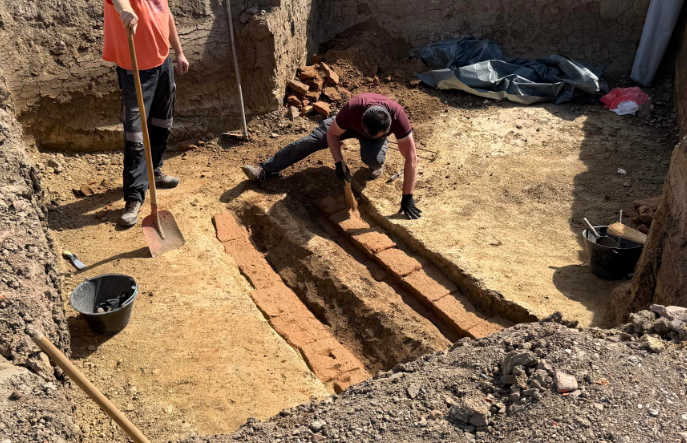
Archaeologists Discover Rare Intact Roman Tomb in Eastern Croatia
Translated from Greek, summarized and contextualized by DistantNews.
TLDR
- Archaeologists in Vinkovci, eastern Croatia, discovered a rare, intact Roman brick tomb containing the remains of a man.
- Intact, unlooted tombs from this period are exceptionally rare, with only two found among over 200 excavated in the area.
- The tomb, dating from the Roman era when Vinkovci was known as Cibalae, yielded minimal grave goods but offered a well-preserved skeleton for analysis.
The discovery of a rare, intact Roman tomb in Vinkovci, eastern Croatia, is a significant archaeological find that resonates deeply with the region's rich historical heritage. Ta Nea, reporting from Greece, would likely frame this as a testament to the enduring legacy of ancient civilizations in the Balkans. However, from a Croatian perspective, this discovery in Vinkovci—historically known as Cibalae—is particularly noteworthy. Cibalae was not just any Roman settlement; it was a crucial military and commercial hub and, significantly, the birthplace of two Roman emperors, Valentinian I and Valens. This makes any archaeological find in the area a direct link to a pivotal period in Roman history and, by extension, to Croatia's own historical narrative. The rarity of an intact tomb, especially one yielding a well-preserved skeleton, offers invaluable insights into Roman burial practices, social status, and daily life. While the grave goods were minimal—an iron object and a bronze fragment—the skeleton itself is a treasure trove of information for researchers. The director of the Vinkovci City Museum, Hrvoje Vulić, rightly points out the exceptional nature of this find, contrasting it with the more common looted tombs. This discovery underscores the importance of ongoing archaeological work in Croatia, which continually unearths layers of history that shape the national identity. It’s a reminder that Croatia’s past is not just about medieval kingdoms or Austro-Hungarian influence, but also stretches back to the Roman Empire, a period that laid foundations for much of European civilization. The find in Vinkovci is more than just an ancient burial; it's a tangible connection to emperors and a significant chapter in the history of the land that is now Croatia.
The construction of the tomb is brick, but unfortunately, the deceased was buried with minimal grave goods. We recorded an iron object next to the right leg and a bronze fragment on the right shoulder. This is a man aged about 40 to 45 years. The skeleton appears in relatively good condition, which is exceptional, as it will allow the extraction of valuable data through analysis.
DistantNews Editorial
Originally published by Ta Nea in Greek. Translated, summarized, and contextualized by our editorial team with added local perspective. Read our editorial standards.
More Stories

From Our Blog

What Gets Lost (and Found) When News Is Translated

The Critical Role of Diaspora Media in Global News

What Travellers Should Know About Countries with Restricted Press

A Digital Nomad's Guide to Following Local News

How the Same Story Looks Different in Different Countries
