


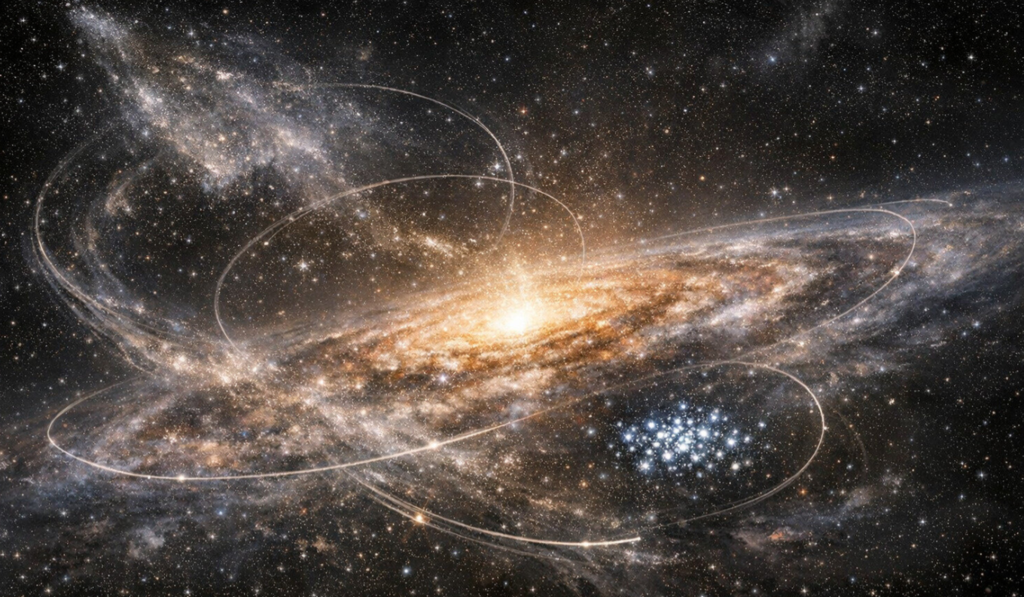
Astronomers Detect Traces of "Lost" Dwarf Galaxy Loki Within Our Own
Translated from Greek, summarized and contextualized by DistantNews.
TLDR
- Astronomers have identified 20 stars likely originating from a "lost" dwarf galaxy named Loki, which merged with the Milky Way early in its history.
- These metal-poor stars, found in the galactic disk, exhibit chemical signatures distinct from other halo stars, suggesting a common origin in an energetic dwarf galaxy.
- The discovery, published in Monthly Notices of the Royal Astronomical Society, provides insights into the Milky Way's formation through galactic mergers.
In a groundbreaking discovery, astronomers have pinpointed traces of a "lost" dwarf galaxy, dubbed Loki, within our own Milky Way. This ancient galaxy is believed to have merged with ours during its nascent stages, contributing to the Milky Way's current structure. The research, published in the esteemed Monthly Notices of the Royal Astronomical Society, focuses on a group of 20 metal-poor stars that exhibit unique chemical properties, setting them apart from other stars in the galactic halo.
These stars, found residing in the galactic disk, possess a chemical fingerprint that strongly suggests they were forged together in Loki. Unlike stars in the halo, which are often remnants of various mergers, these 20 stars share a common origin. Their metal-poor nature indicates they formed early in the universe's history, from material enriched by energetic events like supernovae and neutron star mergers, but not white dwarf explosions. This points to Loki being a short-lived but active dwarf galaxy.
These structural elements merged in the early stages, scattering their stars, gases, and dark matter into the proto-galactic structure. Therefore, the most metal-poor stars are expected to be found in the inner parts of the galaxy, while those added later are likely to have dispersed in the outer halo.
From a Greek perspective, this discovery is particularly fascinating. Our understanding of the cosmos is deeply rooted in ancient philosophy and scientific inquiry. The idea that our own galaxy is a composite of smaller, ancient structures like Loki resonates with a sense of cosmic history and interconnectedness. While Western media might focus on the technical aspects of the discovery, for us, it’s a reminder of the grand, ongoing narrative of the universe, a story in which our own galaxy, and by extension our planet, plays a part. The identification of Loki adds another chapter to this epic tale, underscoring the dynamic and ever-evolving nature of the cosmos we inhabit.
These stars, with the exception of one, exhibit less dispersion in [X/Fe] values compared to the halo and the galactic bulge.
DistantNews Editorial
Originally published by Ta Nea in Greek. Translated, summarized, and contextualized by our editorial team with added local perspective. Read our editorial standards.
More Stories



From Our Blog

What Gets Lost (and Found) When News Is Translated

The Critical Role of Diaspora Media in Global News

What Travellers Should Know About Countries with Restricted Press

A Digital Nomad's Guide to Following Local News

How the Same Story Looks Different in Different Countries
