


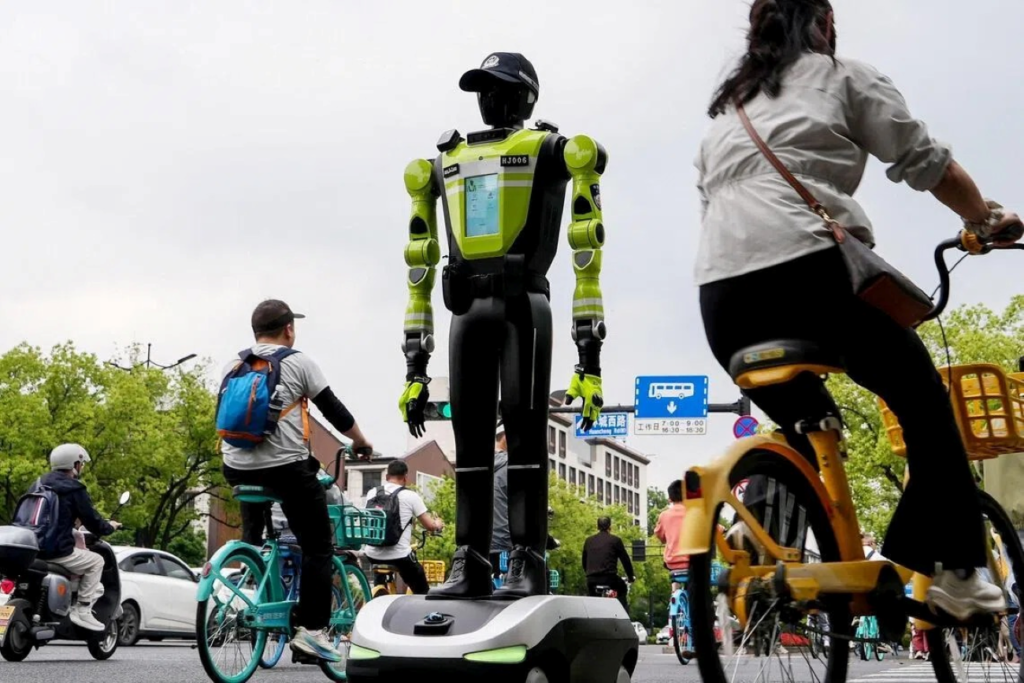
China deploys 'robocops' to manage traffic during public holiday
Translated from Malay, summarized and contextualized by DistantNews.
TLDR
- China deployed robot police officers, nicknamed 'robocops', on roads across the country during a recent five-day public holiday.
- These robots monitored traffic flow and detected violations in busy areas, aiming to assist human officers and enhance efficiency.
- The initiative highlights China's push to integrate advanced robotics into public life and showcases its growing humanoid robotics industry.
In a move that underscores China's relentless march towards technological advancement, robotic police officers, affectionately dubbed 'robocops,' have been deployed on the nation's roadways. During the recent five-day public holiday, these advanced machines took to the streets from Hangzhou to Shenzhen and Xinjiang, diligently monitoring traffic and identifying rule-breakers. This initiative is more than just a temporary measure; it represents a significant stride in China's national strategy to embed sophisticated robotics into every facet of public life, powerfully demonstrating the country's burgeoning prowess in the humanoid robotics sector.
In the southern tech hub of Hangzhou, a squadron of 15 wheeled, humanoid traffic robots was stationed at key intersections, including the popular West Lake tourist area. Clad in bright yellow, these robots were observed issuing verbal warnings to cyclists and e-scooter riders who crossed stop lines. Beyond enforcement, these AI-powered robots offered a novel interactive experience for the public, allowing curious citizens and tourists to ask for directions, make inquiries, or even file police reports via voice command or touchscreen.
The verbal reminder from the robot is more objective and makes it easier for people to accept it.
While traffic robots are not entirely new to China, the Hangzhou deployment marks the establishment of the country's first robot traffic police squadron. According to Hangzhou Daily, in just three days, these robots issued a staggering 11,897 warnings for various traffic offenses, averaging one warning every minute and 43 seconds. A local police official, Chen Sanchuan, noted that the robots' verbal reminders are perceived as more objective and readily accepted by the public, even suggesting their effectiveness surpasses that of human officers.
The Hangzhou Traffic Police explained that the robots are synchronized with traffic light systems, enabling them to issue clear instructions to drivers and pedestrians for stopping, turning, or proceeding. Capable of operating continuously for eight to nine hours daily, these machines are viewed by local authorities as catalysts for productivity, alleviating the burden on existing police personnel and allowing them to focus on more complex tasks, especially during peak traffic hours. A representative from the Hangzhou Public Security Bureau indicated plans to integrate these robots into routine duty schedules post-holiday. Cities like Kashgar in Xinjiang and Ordos in Inner Mongolia have also begun deploying their own robotic traffic controllers.
The effectiveness of the robot's duties is better than that of human officers.
DistantNews Editorial
Originally published by Utusan Malaysia in Malay. Translated, summarized, and contextualized by our editorial team with added local perspective. Read our editorial standards.
More Stories


From Our Blog

What Gets Lost (and Found) When News Is Translated

The Critical Role of Diaspora Media in Global News

What Travellers Should Know About Countries with Restricted Press

A Digital Nomad's Guide to Following Local News

How the Same Story Looks Different in Different Countries
