


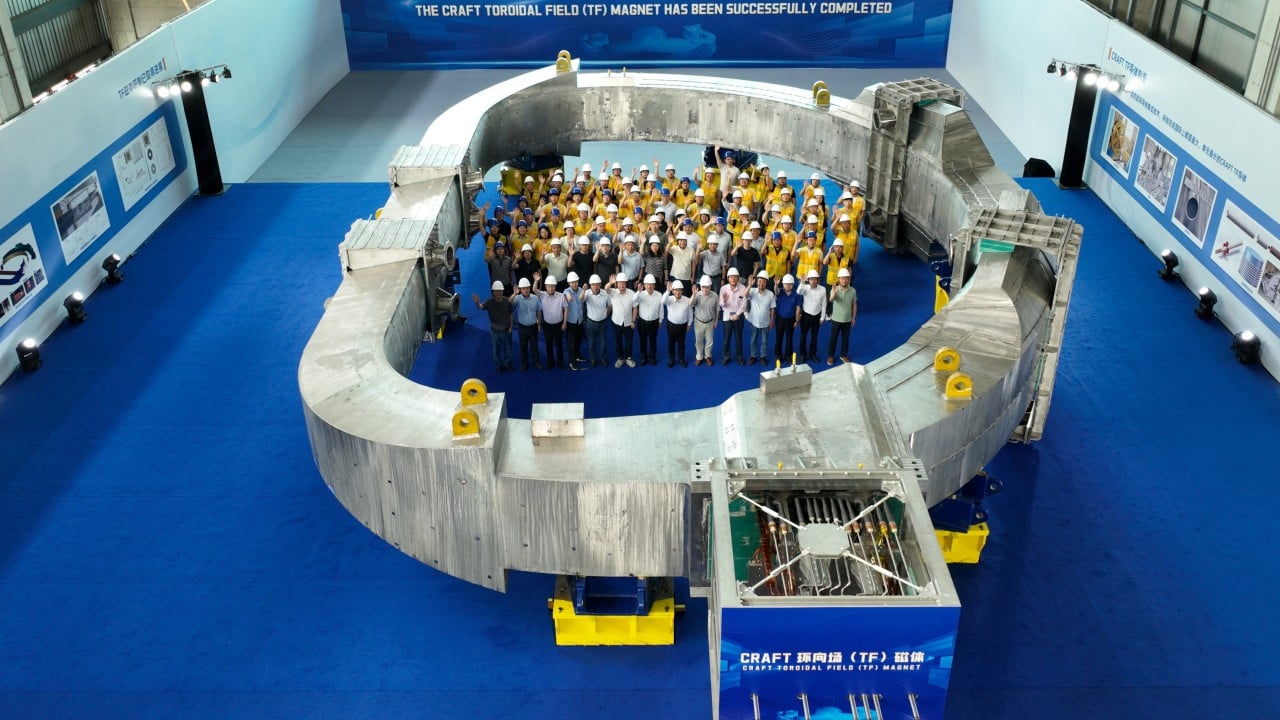
China's 'artificial sun' project achieves milestone with world's largest superconducting magnet
Translated from English, summarized and contextualized by DistantNews.
At a glance
News
From a news agency
New plan
- China has successfully tested the world's largest superconducting magnet for its "artificial sun" nuclear fusion project (CRAFT).
- The magnet's performance surpasses international benchmarks, overcoming a key engineering challenge.
- The CRAFT project aims to create and contain plasma hotter than the sun's core to generate electricity.
China has achieved a significant milestone in its quest for clean energy, successfully passing final tests on the world's largest superconducting magnet for its Comprehensive Research Facility for Fusion Technology (CRAFT) project, often dubbed an "artificial sun." This development eclipses international performance standards and marks a major step forward in nuclear fusion research.
The advanced assembly consists of two critical coils: a toroidal-field magnet designed to act as a magnetic cage, and a central solenoid that functions as the igniter. Researchers at the Institute of Plasma Physics, Chinese Academy of Sciences, reported these results, highlighting the overcoming of a substantial engineering hurdle. This success paves the way for confining plasma at temperatures exceeding that of the sun's core.
The CRAFT project's ambitious goal is to replicate the sun's power on Earth. It aims to generate plasma at over 100 million degrees Celsius (more than 180 million Fahrenheit) and contain it within a doughnut-shaped metal chamber. The toroidal field coil, a crucial component of this reactor, utilizes an immensely powerful magnetic field to prevent the containment vessel from melting under the extreme temperatures of the confined plasma.
DistantNews Editorial
Originally published by South China Morning Post in English. Translated, summarized, and contextualized by our editorial team with added local perspective. Read our editorial standards.
More Stories
From Our Blog

Countries Without a Free Press: What You Need to Know

What Press Freedom Means for the News You Read

What Gets Lost (and Found) When News Is Translated

The Critical Role of Diaspora Media in Global News

What Travellers Should Know About Countries with Restricted Press
