


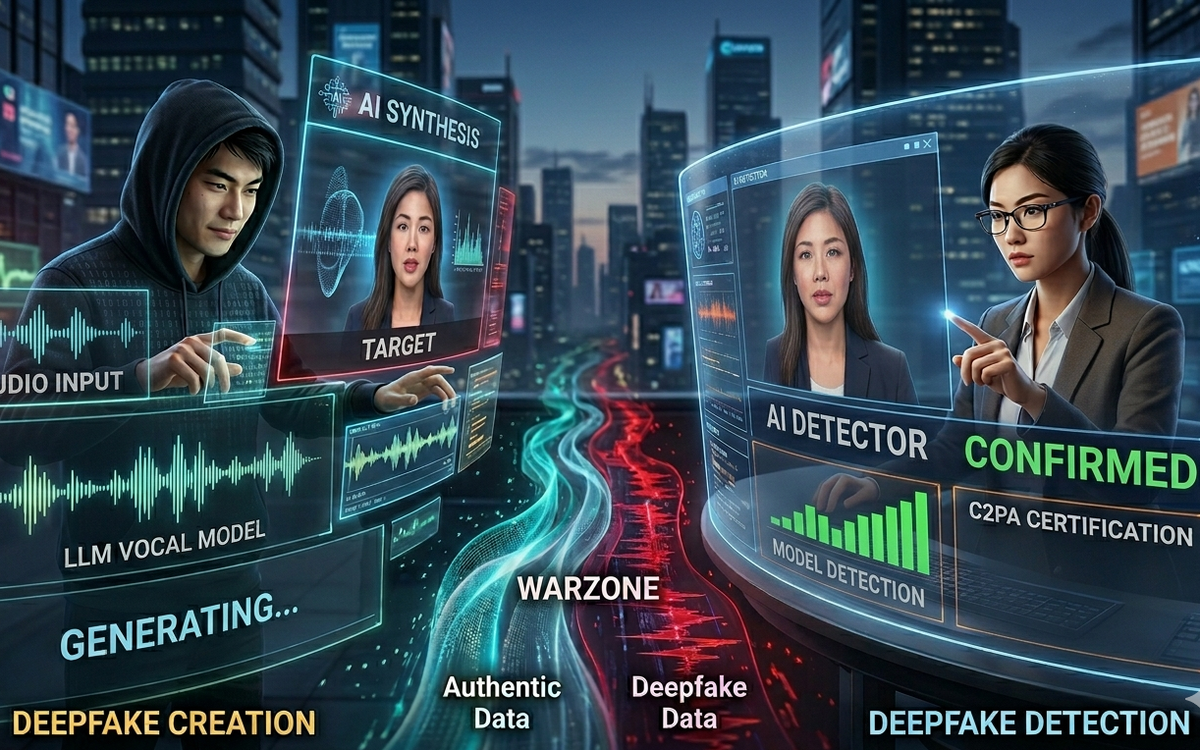
Deepfake Spreads, AI 'Poison-Fighting-Poison' Race Heats Up
Translated from Vietnamese, summarized and contextualized by DistantNews.
TLDR
- The fight against deepfakes is intensifying as AI becomes both a weapon and a shield for cybercriminals and security firms.
- While deepfake technology has advanced significantly, making detection difficult, AI is also being used to develop countermeasures.
- The cost of creating deepfakes is decreasing, while detection and defense require substantial resources, leading to an ongoing technological arms race.
In Vietnam, the escalating battle against deepfakes highlights a critical juncture in the digital age. As artificial intelligence evolves, it presents a dual-edged sword: empowering malicious actors with increasingly sophisticated tools for deception while simultaneously offering the means for defense. The erosion of trust in digital content, where 'seeing is believing' no longer holds true, poses a significant threat not just to individuals but to the integrity of information itself.
The sophistication of deepfakes has surpassed rudimentary detection methods. AI can now replicate images and voices with uncanny accuracy, even mimicking subtle vocal inflections. This technological leap means that while our intuition might still catch anomalies in casual settings, the high-pressure environments of business and finance are particularly vulnerable. The speed of information processing and the urgency often present in financial transactions can lead to critical errors, making individuals and organizations susceptible to elaborate scams.
Cybercriminals are exploiting this vulnerability through organized fraud schemes. By harvesting publicly available data from social media, they can construct convincing voice simulations of company employees, impersonating leaders or colleagues to solicit fraudulent money transfers. The financial losses from such deepfake-induced scams can be substantial, reaching hundreds of thousands of dollars per incident. The psychological manipulation, often playing on urgency or familial distress, further lowers victims' guard, enabling rapid exploitation.
To combat this pervasive threat, security startups are adopting a 'fight fire with fire' approach, leveraging AI to detect deepfakes. This involves training machine learning models on vast datasets of both real and fabricated content to identify subtle digital artifacts invisible to the human eye. This creates a continuous cycle of innovation: as deepfakes become more advanced, detection systems must constantly evolve, fueling a relentless technological arms race. However, the disparity in costs—cheap creation versus expensive defense—presents a significant challenge. The development of content authentication standards is a promising avenue, but ensuring the integrity of verification systems remains crucial. Ultimately, deepfake detection tools are expected to become a standard layer of digital security, akin to antivirus software, integrated seamlessly into our online experience.
In a test by reporter Gaby Del Valle, just 9 seconds of audio collected from social media allowed an AI system to create a fake version capable of maintaining a nearly convincing conversation.
DistantNews Editorial
Originally published by Tuổi Trẻ in Vietnamese. Translated, summarized, and contextualized by our editorial team with added local perspective. Read our editorial standards.
More Stories



From Our Blog

What Gets Lost (and Found) When News Is Translated

The Critical Role of Diaspora Media in Global News

What Travellers Should Know About Countries with Restricted Press

A Digital Nomad's Guide to Following Local News

How the Same Story Looks Different in Different Countries
