


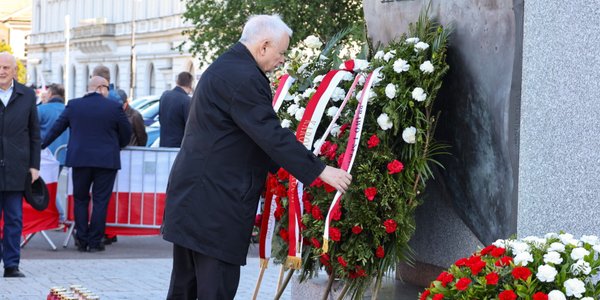
Kaczyński Claims Russian Agents Active in Poland During Smoleńsk Anniversary
Translated from Polish, summarized and contextualized by DistantNews.
TLDR
- During commemorations of the Smoleńsk catastrophe, Law and Justice (PiS) party leader Jarosław Kaczyński claimed Russian agents are active and influencing events in Poland.
- Kaczyński asserted that evidence of a deliberate attack exists and expressed belief that fair courts will eventually resolve the issue, leading to accountability for those involved.
- The event, marked by the laying of wreaths and speeches, also saw a small group protesting, while police maintained order.
Warsaw, Poland – The annual commemoration of the Smoleńsk air disaster, a deeply sensitive event in Polish national memory, once again became a platform for strong political rhetoric, particularly from Jarosław Kaczyński, the leader of the Law and Justice (PiS) party. Speaking amidst the solemnity of Piłsudski Square, Kaczyński did not shy away from his party's long-held narrative: that the 2010 tragedy was not merely an accident, but a deliberate act orchestrated by Russia. His pronouncements about "Russian agents" and "Putin's agents" operating within Poland are a stark reminder of the ongoing political polarization surrounding the catastrophe.
As usual, one must speak amidst shouts and screams. Russian agents, Putin's agents are operating here.
From the perspective of PiS and its supporters, the Smoleńsk disaster remains an open wound, a symbol of national tragedy intertwined with perceived Russian aggression and internal betrayal. Kaczyński's insistence on the existence of evidence for an "attack" and his faith in "independent and honest courts" to eventually deliver justice reflects a deep-seated belief that the truth has been suppressed. This narrative positions Russia as an unrepentant aggressor and suggests that elements within Poland may have been complicit or negligent, thereby preventing full accountability. The call for justice is framed not just as a historical reckoning, but as a necessary step for national security and sovereignty.
We believe, and it will happen, that the day will come when independent and honest courts will resolve this problem once and for all.
This viewpoint stands in stark contrast to the official findings of Polish and Russian investigations, which concluded the crash was accidental, caused by a combination of pilot error in adverse weather conditions and technical failures. However, for many PiS loyalists, these official explanations are insufficient, even part of a cover-up. The recurring theme of "Russian agents" serves to reinforce the idea of an ongoing external threat, justifying a hardline stance against Russia and often used to critique political opponents perceived as too lenient. The presence of counter-protesters, though small, highlights the division within Polish society regarding the interpretation of the Smoleńsk event.
The fact that there is no evidence is a lie. One must fight hard for it, because a significant part of our society does not want to accept this truth; this hard, painful, unpleasant, dangerous truth about the attack, about the crime committed by Putin and his associates.
What makes this commemoration particularly significant from a Polish viewpoint is its enduring political weight. The Smoleńsk disaster claimed the lives of the President, the First Lady, high-ranking government officials, and military leaders, representing a catastrophic loss for the nation. For Kaczyński and PiS, keeping this narrative alive is not just about historical remembrance; it's a crucial element of their political identity and a tool for mobilizing their base. The demand for justice, framed through the lens of conspiracy and foreign interference, continues to shape political discourse and foreign policy considerations in Poland, underscoring the event's lasting impact on the nation's psyche.
These people will not be able to show their faces here, because they will simply be in another place, and even after leaving that place, they will be banned from this place for many years.
DistantNews Editorial
Originally published by Rzeczpospolita in Polish. Translated, summarized, and contextualized by our editorial team with added local perspective. Read our editorial standards.
More Stories


From Our Blog

What Gets Lost (and Found) When News Is Translated

The Critical Role of Diaspora Media in Global News

What Travellers Should Know About Countries with Restricted Press

A Digital Nomad's Guide to Following Local News

How the Same Story Looks Different in Different Countries
