


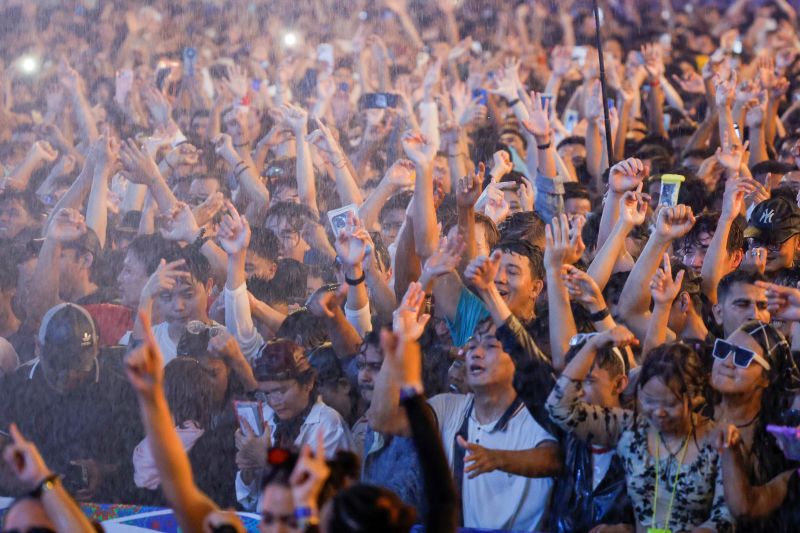
Malaysia Warned Against Blindly Copying Foreign Entertainment Models
Translated from Malay, summarized and contextualized by DistantNews.
TLDR
- PAS Selangor Information Chief Dr. Yusfarizal Yussoff cautioned the Malaysian government against blindly imitating foreign entertainment models, citing the "Hujan Disco" event as an example.
- He argued that such imitation, driven by 'fear of missing out' (FOMO), disregards local values and the sensitivities of the Muslim majority.
- Yusfarizal urged the government to focus on promoting Malaysia's own cultural products and uphold principles of modesty and local values, aligning with the Rukun Negara's emphasis on courtesy and good conduct.
This commentary from Utusan Malaysia, featuring Dr. Yusfarizal Yussoff of PAS Selangor, voices a strong critique of the Malaysian government's cultural and entertainment policies. The core argument is a warning against excessive emulation of foreign entertainment trends, particularly those that may clash with local values and the sensibilities of the Muslim majority. The term 'fomo' (fear of missing out) is used critically, suggesting that the government's pursuit of international tourism through foreign entertainment models is misguided and potentially detrimental to Malaysia's unique identity.
Jangan tukar produk terbaik kita dengan produk luar, hanya kerana kita fomo.
The article frames the issue as a conflict between embracing global trends and preserving national identity. Dr. Yusfarizal contends that Malaysia possesses its own rich cultural products that should be leveraged for tourism rather than adopting foreign entertainment styles wholesale. The example of 'Hujan Disco' serves as a focal point for this critique, implying that such events may not be culturally appropriate or sensitive to the predominantly Muslim population.
Kita bukan minta Malaysia jadi negara taliban yang haramkan semua hiburan. Kita mahu Malaysia jadi negara Timur yang sopan, tinggi nilai budaya dan menghormati cara hidup tempatan.
From the perspective presented, Malaysia should strive to be a "Eastern country that is polite, high in cultural values, and respects local ways of life," rather than adopting a model that might compromise these principles. This aligns with a conservative viewpoint that emphasizes the importance of maintaining cultural integrity and religious sensitivities in public life. The commentary stresses that Islam, as the federal religion, influences not just religious observance but also social conduct, including norms around interaction between genders, dress code, and entertainment.
Bagi umat Islam, batasan pergaulan lelaki dan wanita, peraturan aurat dan larangan hiburan berlebihan itu menyelamatkan manusia kerana menjaga maqasid nasab, maruah dan akal.
The piece calls for a government that actively promotes and develops local attractions and cultural assets, rather than chasing fleeting international trends. It advocates for a balanced approach where economic development, particularly in tourism, goes hand-in-hand with the preservation of moral and ethical standards, as enshrined in the Rukun Negara. The underlying message is a call for cultural self-reliance and a rejection of policies that might dilute Malaysia's distinct cultural fabric in pursuit of external validation.
prinsip Rukun Negara khususnya kesopanan dan kesusilaan perlu benar-benar diterjemahkan dalam dasar kerajaan dan penganjuran program awam agar pembangunan ekonomi seiring dengan pembangunan akhlak masyarakat.
DistantNews Editorial
Originally published by Utusan Malaysia in Malay. Translated, summarized, and contextualized by our editorial team with added local perspective. Read our editorial standards.
More Stories



From Our Blog

What Gets Lost (and Found) When News Is Translated

The Critical Role of Diaspora Media in Global News

What Travellers Should Know About Countries with Restricted Press

A Digital Nomad's Guide to Following Local News

How the Same Story Looks Different in Different Countries
