


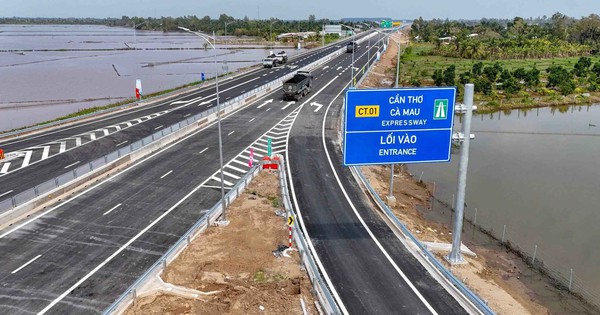
Phương Nam đột phá hạ tầng chiến lược
Translated from Vietnamese, summarized and contextualized by DistantNews.
TLDR
- Vietnam is rapidly expanding its highway network in the southern region, significantly increasing the total length of expressways.
- By the end of April, the remaining four North-South expressway projects in the South Central region will be completed, totaling 268 km.
- The expansion includes key projects like the Can Tho - Ca Mau expressway, which has shortened travel time from Ca Mau to Ho Chi Minh City to 4-5 hours, and future projects aiming to connect the Mekong Delta region more effectively.
Vietnam is witnessing a dramatic transformation of its southern transportation infrastructure, with a significant acceleration in the development of its expressway network. This surge in construction, particularly along the North-South corridor, is reshaping connectivity and promising to unlock substantial economic potential for the region.
The North-South expressway projects remaining in the South Central region (totaling 268 km) including the sections of Quang Ngai - Hoai Nhon, Hoai Nhon - Quy Nhon, Quy Nhon - Chi Thanh and Chi Thanh - Van Phong will be completed by the end of April, timely serving the travel needs of the people during the holiday.
As of late April, the completion of four key expressway projects in the South Central region—spanning a total of 268 km—marks a critical milestone. These include the Quang Ngai - Hoai Nhon, Hoai Nhon - Quy Nhon, Quy Nhon - Chi Thanh, and Chi Thanh - Van Phong sections. This development is not just about adding kilometers of road; it's about creating vital arteries that will facilitate smoother travel and commerce, especially in time for the April 30th holiday, a significant national commemoration.
Before 2020, the entire southern region had only about 90 km of expressways. But in just 5 years of the 2021-2025 term, the efforts of the Government and localities have redrawn the map of the southern expressway network, increasing the total length of the expressway system to over 900 km.
The impact of this infrastructure push is particularly evident when comparing the current state to the pre-2020 period. What was once a region with only about 90 km of expressways has, in just five years (2021-2025), seen its network expand to over 900 km. Projects like the Trung Luong - My Thuan, My Thuan - Can Tho, My Thuan 2 Bridge, and Phan Thiet - Dau Giay have been instrumental in this growth. The recent opening of the Can Tho - Ca Mau expressway, a nearly 270 km route, is a landmark achievement for the Mekong Delta, reducing travel time to Ho Chi Minh City from 10 hours to a mere 4-5 hours, effectively creating a primary road backbone for this crucial agricultural hub.
From an expressway 'lowland', after many years of waiting, mid-January 2026 will mark a special milestone for the people of the Mekong Delta when the Can Tho - Ca Mau expressway officially opens to traffic, completely connecting the expressway axis from Ho Chi Minh City to the southernmost tip of the country.
Looking ahead, further expansion is planned, with projects like Chau Doc - Can Tho - Soc Trang and Cao Lanh - An Huu - Duc Hoa - Chon Thanh set to add approximately 600 km of expressways to the Mekong Delta alone. These projects are designed not only to shorten travel times but also to enhance connectivity to major seaports, thereby boosting regional economic development. As highlighted by experts like PGS-TS Nguyen Hong Thai, this period represents a determined effort to overcome long-standing infrastructure bottlenecks, aligning with Vietnam's broader economic growth and urbanization strategies. The rapid development signifies a national commitment to modernizing its infrastructure and integrating its regions more effectively.
This shows a very strong determination to remove the infrastructure 'bottlenecks' that have existed for many years.
DistantNews Editorial
Originally published by Thanh Niên in Vietnamese. Translated, summarized, and contextualized by our editorial team with added local perspective. Read our editorial standards.
More Stories
From Our Blog

What Gets Lost (and Found) When News Is Translated

The Critical Role of Diaspora Media in Global News

What Travellers Should Know About Countries with Restricted Press

A Digital Nomad's Guide to Following Local News

How the Same Story Looks Different in Different Countries
