


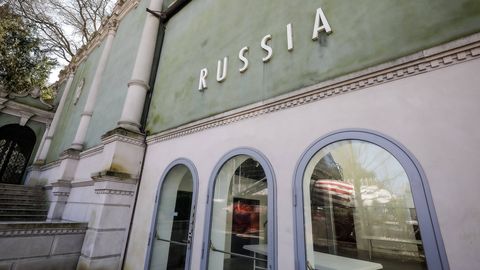
Venice Biennale Jury Resigns, Awards Unlikely Amidst Millions-Euro Loss
Translated from Estonian, summarized and contextualized by DistantNews.
TLDR
- The jury for the Venice Biennale announced their resignation in full just nine days before the prestigious art event's opening.
- The decision stems from escalating tensions regarding Russia's return to the exhibition for the first time since the full-scale invasion of Ukraine.
- The jury stated they stand by their previous decision not to consider countries whose leaders face accusations of crimes against humanity for awards, effectively excluding Russia and Israel from competition.
A significant crisis has erupted at the Venice Biennale, one of the world's foremost art exhibitions, with the entire jury resigning just days before its scheduled opening. This dramatic move signals deep divisions and ethical concerns surrounding the inclusion of Russia in the event, particularly in light of the ongoing conflict in Ukraine.
The jury's collective resignation is a powerful statement against the Biennale's decision to allow Russia to participate. Their adherence to a principle of not awarding nations whose leaders are accused of crimes against humanity clearly puts them at odds with the organizing committee. This stance, which also implicitly includes Israel due to ongoing international scrutiny, highlights a moral red line for the jurors.
From an Estonian perspective, as reported by Postimees, this situation raises critical questions about the role of art in international politics and the responsibility of cultural institutions. The Biennale, typically a platform for global dialogue and artistic expression, finds itself embroiled in controversy that overshadows the art itself. The potential loss of millions of euros due to this stalemate further underscores the gravity of the situation.
The decision to exclude countries based on leadership's alleged crimes against humanity is a complex one, fraught with political and ethical implications. However, for many, especially in nations directly affected by or deeply concerned about international conflicts, this stance is a necessary one. It reflects a desire to ensure that major cultural platforms do not inadvertently legitimize or normalize actions that violate fundamental human rights. The absence of awards due to this dispute leaves a shadow over the event, prompting reflection on how such prestigious gatherings navigate geopolitical realities.
DistantNews Editorial
Originally published by Postimees in Estonian. Translated, summarized, and contextualized by our editorial team with added local perspective. Read our editorial standards.
More Stories
/nginx/o/2026/04/29/17599467t1hdec5.jpg)

/nginx/o/2026/04/21/17583844t1h87f6.jpg)
From Our Blog

What Gets Lost (and Found) When News Is Translated

The Critical Role of Diaspora Media in Global News

What Travellers Should Know About Countries with Restricted Press

A Digital Nomad's Guide to Following Local News

How the Same Story Looks Different in Different Countries
