


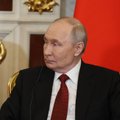
Why Putin Offers Ceasefire on May 9th – Can't Even Ensure Security in Moscow?
Translated from Lithuanian, summarized and contextualized by DistantNews.
TLDR
- Russia's President Putin has proposed a ceasefire in Ukraine to coincide with Victory Day on May 9th, a move questioned by Ukrainian officials.
- Ukrainian officials suggest Putin's offer is a propaganda stunt, aimed at masking security concerns for the upcoming Moscow parade rather than signaling a genuine desire for peace.
- The proposal follows a pattern where Russia has presented ceasefire offers as its own initiative, even after Ukraine initially proposed them, while military actions continued.
The Kremlin's latest proposal for a ceasefire in Ukraine, timed to coincide with Victory Day on May 9th, has been met with skepticism and sharp criticism from Ukrainian officials. The offer, presented as a gesture of goodwill by President Putin, is widely viewed in Kyiv not as a step towards peace, but as a calculated propaganda move.
So, Putin is worried about the May 9th parade, so he decided to pretend that he is ready to 'stop the fire for one day' and present it as a big service? This is ridiculous and completely unrelated to the approaching end of the war.
Andriy Kovalenko, head of the Center for Combating Disinformation, dismissed the proposal as "ridiculous" and "completely unrelated to the approaching end of the war." He argued that Putin's primary concern is the security of the Victory Day parade in Moscow, suggesting that the ceasefire offer is a ploy to distract from Russia's inability to guarantee safety even within its own capital. "He is worried about his propaganda event, because he cannot ensure any security even in Moscow," Kovalenko stated, adding that Russia is attempting to frame this as a magnanimous service.
This narrative is further supported by historical context. Just weeks prior, Putin announced a 'Easter truce' after Ukraine had already publicly proposed one. Despite this, Russian forces reportedly conducted over 10,000 attacks during the supposed truce period, particularly in the direction of Pokrovsk. This pattern suggests that Russian ceasefire announcements often serve as a cover for continued military operations.
However, no – he is concerned about his propaganda event, because he cannot ensure any security even in Moscow. And it is still being presented as a Russian service.
The announcement was made by Yuri Ushakov, an aide to the Kremlin chief, who claimed Putin informed U.S. President Donald Trump about the readiness to declare a ceasefire, with Trump reportedly being receptive. However, from Ukraine's perspective, this is another instance of Russia attempting to manipulate the international narrative, portraying itself as a peacemaker while its military actions on the ground tell a different story. The true intention behind the May 9th proposal remains a subject of intense scrutiny, with Ukraine emphasizing that genuine peace would involve Russia simply ending the war.
Trump 'actively supported' this initiative, indicating that this holiday symbolizes a common victory over Nazism in World War II.
DistantNews Editorial
Originally published by Delfi in Lithuanian. Translated, summarized, and contextualized by our editorial team with added local perspective. Read our editorial standards.
More Stories

From Our Blog

What Gets Lost (and Found) When News Is Translated

The Critical Role of Diaspora Media in Global News

What Travellers Should Know About Countries with Restricted Press

A Digital Nomad's Guide to Following Local News

How the Same Story Looks Different in Different Countries
