

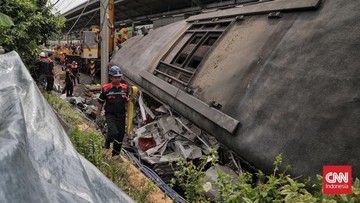

Train Collision in Bekasi: 46 Victims Still Under Observation in Hospitals
Translated from Indonesian, summarized and contextualized by DistantNews.
TLDR
- A train collision between the Argo Bromo Anggrek and a Commuter Line (KRL) in Bekasi, Indonesia, resulted in 16 fatalities and 90 injuries.
- The incident occurred when the Argo Bromo Anggrek train struck the KRL from behind at high speed after the KRL was delayed by a stalled online taxi.
- The collision caused significant damage, with the Argo Bromo Anggrek train penetrating the KRL, particularly affecting the women-only carriage.
The tragic train collision that occurred near Bekasi Station on April 27, 2026, is a devastating event that has deeply impacted the Indonesian community. As reported by Tempo, the accident, involving the Argo Bromo Anggrek express train and a Commuter Line (KRL), resulted in a grim toll of 16 lives lost and 90 individuals injured, with 46 still under observation. The loss of life, particularly the confirmation that all fatalities were women, including students and working professionals, adds a layer of profound sorrow to this already horrific incident.
Update April 29, 2026, 11:00 AM WIB for one patient who died, name MC.
The sequence of events leading to the collision paints a picture of unfortunate circumstances and potential systemic failures. The initial disruption caused by an online taxi stalling on the tracks created a dangerous bottleneck. The Argo Bromo Anggrek, reportedly traveling at a high speed of 110 kilometers per hour, then collided with the stationary KRL, with catastrophic consequences. The image of the express train's body piercing the KRL, specifically the women's carriage, is a stark and harrowing detail that underscores the violence of the impact.
A total of 90 victims are still being treated in various hospitals. Forty-four patients have returned home and 46 others are under observation.
From an Indonesian perspective, this accident is more than just a statistic; it represents a failure to ensure the safety of public transportation, a vital service for millions. While PT Kereta Api Indonesia (KAI) is involved in the identification of victims and the aftermath, the focus must inevitably turn to prevention. Questions will undoubtedly arise about track safety protocols, train speed regulations, and emergency response procedures. The fact that the KRL was delayed on the tracks, creating a vulnerability, and that the express train was traveling at such a high speed in proximity, points to critical safety oversights. Tempo's reporting aims to capture the gravity of the human tragedy while also seeking clarity on the operational factors that contributed to this disaster, urging a thorough investigation to prevent future occurrences.
The speed was 110 kilometers per hour.
DistantNews Editorial
Originally published by Tempo in Indonesian. Translated, summarized, and contextualized by our editorial team with added local perspective. Read our editorial standards.
More Stories



From Our Blog

What Gets Lost (and Found) When News Is Translated

The Critical Role of Diaspora Media in Global News

What Travellers Should Know About Countries with Restricted Press

A Digital Nomad's Guide to Following Local News

How the Same Story Looks Different in Different Countries
