


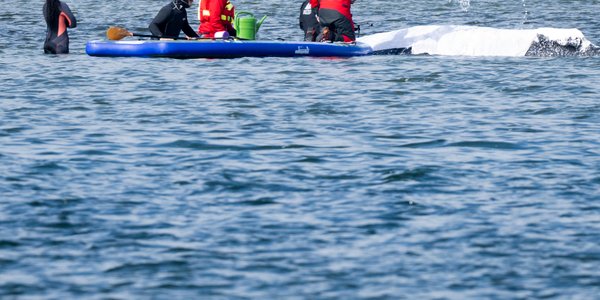
Whale Stranded in Baltic Sea; Experts Criticize Rescue Mission as "Cruel"
Translated from Polish, summarized and contextualized by DistantNews.
TLDR
- A humpback whale, nicknamed "Timmy," has been stranded in shallow waters off the German Baltic Sea coast for weeks, posing a significant threat to its life.
- Despite the animal's deteriorating health, including a fishing net in its mouth and skin lesions, a privately funded rescue operation is preparing to transport it to the North Sea.
- Many experts strongly advise against the rescue attempt, deeming it futile and potentially cruel, citing the whale's poor prognosis and the risks associated with the complex operation.
The plight of "Timmy," the humpback whale stranded in the Baltic Sea, has captured the attention of many, but the proposed rescue operation is fraught with controversy and expert skepticism. For weeks, this magnificent creature has been trapped in shallow waters near the island of Poel, its health visibly declining. While a large-scale rescue is being prepared, involving air cushions and a specialized barge, a significant portion of the scientific community, including prominent figures like Burkard Baschek, director of the Oceanographic Museum in Stralsund, strongly opposes the effort. Experts argue that the whale's condition is too severe, citing a fishing net lodged in its mouth and numerous skin lesions, making survival highly unlikely even if rescued. Baschek has gone as far as to call further rescue attempts "pure cruelty," emphasizing that the repeated strandings have severely worsened the animal's prognosis. Despite these dire warnings, a group of private individuals, backed by wealthy entrepreneurs, has taken the initiative and financial responsibility for the operation. This situation highlights a stark divide between public emotion and expert opinion. While thousands flock to the coast to witness the events, and some even attempt to interfere, scientists and officials face threats for their pragmatic, albeit grim, assessments. This divergence is particularly pronounced in Germany, where there's a strong public sentiment for intervention, often clashing with the more detached, evidence-based approach favored by international marine biologists. The German media, like Rzeczpospolita, reflects this tension, reporting on both the public's emotional engagement and the experts' critical stance, questioning whether the rescue is a genuine act of compassion or a misguided, potentially harmful endeavor.
Próba ratunku nie ma już sensu
DistantNews Editorial
Originally published by Rzeczpospolita in Polish. Translated, summarized, and contextualized by our editorial team with added local perspective. Read our editorial standards.
More Stories



From Our Blog

What Gets Lost (and Found) When News Is Translated

The Critical Role of Diaspora Media in Global News

What Travellers Should Know About Countries with Restricted Press

A Digital Nomad's Guide to Following Local News

How the Same Story Looks Different in Different Countries
